

Threat Level: Midnight
The Post-Liberal Obsession with What Time It Is

Temporality – the business of time – is often an important feature in right-wing thought. Typically, conservatives conjure something like a golden era of the recent past, or a decline into a fallen future. Both imaginaries are often presented simultaneously, as the forces that overthrew the golden era press on into decline. There is some irony to this un-stated emphasis on time and its trajectory since conservative thinkers typically reject whiggish or progressive claims about the linear direction of history.
The historicity of the imagined past, the certainty of the future decline, and the possibility of reconstructing the past all tend to be un- or underexamined, as with the role of temporality in conservative thinking generally. Not so with the post-liberal concept of “knowing what time it is.”
According to the hard-right mouthpiece and originator of the slogan Dave Reaboi, it is “shorthand for, ‘do you recognize or realize where we are in the movie?,’” shoehorning the recent past into a pop-cultural narrative structure.
The phrase is obviously a temporal metaphor. We are at minutes to midnight on the Doomsday Clock; we’re riding a train hurtling over a cliff; we’re aboard Flight 93 on September 11. The hour is late, act now before imminent destruction.

In some respects, it’s seductively appealing. It implies the holder has special knowledge or an insight into reality that their interlocutor lacks. If the time-knower claims an esoteric authority, he also presents the entirety of society’s political and epistemological structure as oppressive and untrustworthy.
Reaboi explains further that knowing what time it is means recognizing “what happens after 50, 60, or 100 years of the success of the Progressive project? What happens after 50 or 100 years of success of the Long March through the institutions?”
In his view, America is fundamentally “no longer the country we were,” drawing on parallels to the collapse of Roman and other empires. The decadent United States is on its way out.
It’s not uncommon for second-tier right-wing influencers or anonymous anime nationalists to use the phrase. Ben Weingarten suggests that “a shared understanding of the stakes is inherent” to National Conservatism – the dissident hard-right movement that aims to displace fusionist conservatism and provide the intellectual architecture to Trumpism. The injunction “to know what time it is” is an explicit call to recognize the stakes; it distils the logic of the “Flight 93 Election” into a call to arms.
More importantly, it has escaped containment. The most post-liberal members of the administration have slipped the term into their public statements. “The Federalist Society doesn’t know what time it is,” complained Russell Vought late in 2023, knocking the conservative legal establishment. In his campaign to become Senator for Ohio, J. D. Vance extemporaneously remarked that “It is time to send people who know what time it is” to combat corporations, bureaucracies, and the Biden administration undermining traditional values. “That’s me,” he said.
As a rhetorical device, “knowing what time it is” functions on many levels. It’s a shibboleth, an implied argument, an intensifier. It captures the American conservative movement’s persistent tendency toward apocalypticism and exaggerates it into a political program. Ultimately, the demand to recognize where we are in the movie or in the arc of history is unfalsifiable and dangerous to democracy (in some cases, intentionally so).
Recognizing the “time” is meant as a marker. It separates those who are meeting the moment from apolitical normies or insufficiently awake (woke?) conservatives. As a shibboleth, the phrase signals that its user is part of the counterrevolutionary milieu. They understand the stakes, reject the present, and are willing to do something about it.
Argumentatively, the temporal metaphor parallels the Marxist concept of “false consciousness.” In Marxist theory, an oppressed class adopts the ideology of the oppressors. They misapprehend the economic realities of their class status and buy the myths of the governing class. Allegations of false consciousness were used to undercut critics or rivals of Marxist movements as gullible or captured tools of bourgeois rule. This is precisely how the hard right sees establishment or moderate conservatives. “I’m sorry but these days when I read the phrases ‘market-oriented’ and ‘limited government’ coming from people on the right I kind of throw up in my mouth a little,” Weingarten quotes a colleague. Right-wing allegations of false consciousness – while relying on systemic cultural delusion rather than an economic one – are used to dismiss their conservative critics out of hand. The Robert Georges and David Frenches of the world simply do not understand.
Of course, the apocalyptic sense that the world is ending isn’t new to the right. There is something about the fact that conservative thought typically seeks to defend structures and hierarchies under active challenge that tends toward panic and Chicken Littleism. The conservative movement’s chief thinkers have always had their own apocalyptic temptations. “Knowing what time it is” is a logical heightening of this tendency.
In conservative writing, liberals (conflated with the left) are almost always presented as powerful, unified, and on the march.
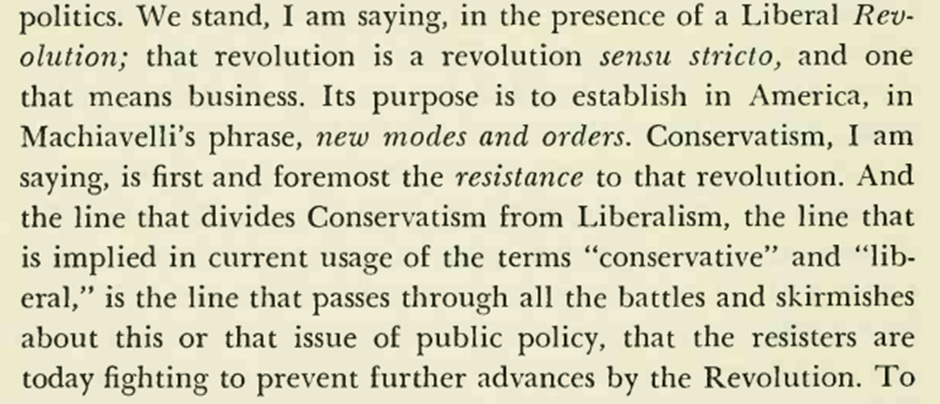
The argument that liberal or left-wing demands threaten something of great value (liberty, civilization, safety, divine order, and so on) is so consistent on the right that Albert Hirschman identified it – the argument from jeopardy – as one of the core rhetorics of reaction. The jeopardy argument is often a powerful one, including in a democracy. As people, we are deeply averse to losing something we have that the threat thereof in the political space is often a convincing motivator. It doesn’t take much to convince people things can get worse.
Hirschman finds that in the Anglosphere, conservative appeals to jeopardy focus on the tension between liberty and solidarity. You can see that in some of the uses of “knowing what time it is.” Reaboi warns about a coming tyranny, for instance. In general, though, I think the hard right presents the jeopardy facing Americans as an imposition on liberty, but something more: something cultural and even civilizational in scope. They imagine a progressive managerial class presiding over the ruins of the West.
The “time it is” argument goes beyond jeopardy, really, and warns of urgent cataclysm. It demands action from its exaggerated reading of the present, forcing the issue of contemporary politics through the sales tactic of false urgency. In doing so, it comes to more closely resemble its opposite: a position Hirschman called “the imminent-danger thesis,” an argument he associated with the left.
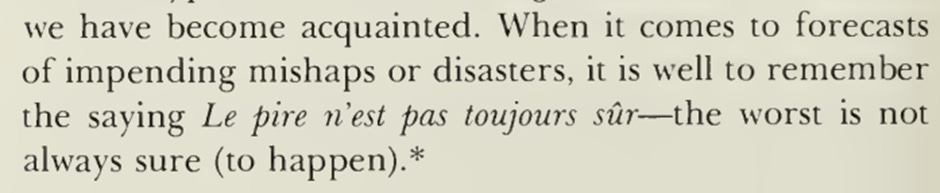
Both of these arguments – jeopardy and imminent-danger – are faulty. They overstate their cases (history is not nearly so linear) and are unfalsifiable (how can one argue against a prediction about the future?). The longer the time drags out without a progressive tyranny, the less convincing it becomes.
And since the future is unfalsifiable, the demand we know what time it is must always be a claim about the present. It is the current, everyday cultural conditions that post-liberals deplore.
I always think it’s worth giving conservatives their due here by noting that, yes, there has been profound social, cultural and legal change in the United States (and across the world) since the beginnings of the conservative movement. Things that were once assumed to be true, or not even thought about at all, have been overturned. Hierarchies and certainties related to gender, race, religion and the religious makeup of the United States, marriage, sexuality, even the nature of gender and sexuality have been destabilized. As Weingarten puts it, “We do not share a common belief in our history, the righteousness of our cause, or the cultural basis for a free and flourishing society.”
Post-liberals will regularly point to the political order as the source of their fears. But this position is belied by the way Trump won two close elections, Republicans control Congress, and conservative justices dominate the Supreme Court. Instead, I think the real source of post-liberal fear – what has shifted the clocks, so to speak – is the totality of this cultural shift.
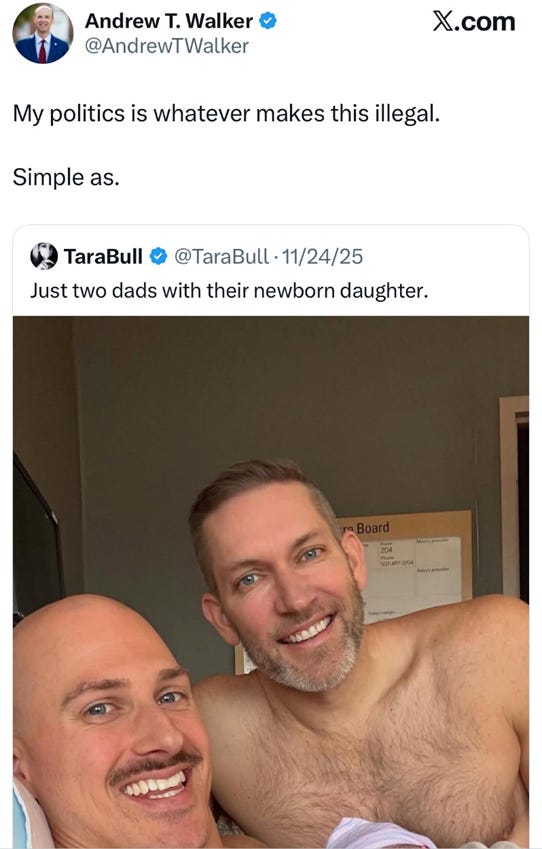
Post-liberals, at least ones that use their real names, tend to be coy about what exactly they feel they have lost over the past half century. The anon accounts (and now official ones) pioneering National Conservative realism tend to be a bit more explicit. In the end, the vision inevitably amounts to a white, heteronormative, performatively religious, patriarchal society and predicated on the singular post-WWII economy, all laundered through nostalgic memory and imagery.
Yet, despite these real cultural changes, the republic has persisted. If pushed, I think the idealized regime of yesteryear is really only appealing to a small number of people, and insofar as it seeks to build it, the post-liberal project is doomed to founder on the shoals of Americans’ culturally libertarian revealed preferences. At the same time, while the goals are narrow, the rhetoric of fear and grievance do mobilize a much larger and more diverse group of people.
It’s hard to escape the slightly subterranean violence in the phrase too. The urgency of the moment demands it. Consider the markers of someone who doesn’t recognize the time. They have faith in norms, including the democratic process and liberal traditions about speech, arguments, and politics. They believe in civility and debate. Above all, they believe in forbearance: that vital ingredient of democracy that refuses to see political opponents as enemies.
Those who know what time it is deny liberal democratic norms and consciously reject civility. Their vulgar Schmittianism demands the end of forbearance. The position is anti-democratic and, I think, animated by a desire to punish those they deem responsible for the cultural changes they deplore. What is “Look at what they took from you” – that other cliché of anime nationalists – if not a demand for some kind of retribution?
The post-liberals think they are both weak and strong simultaneously. They believe progressive cultural and political dominance demand extraordinary political action, but they also believe they – at last – have the political power to effect that action. The most coherent version of this paradox is that the post-liberals now feel strong after having suffered a period in the wilderness. They have, I think, over-read the results of the 2024 election – an easy mistake to make.
In the end, the politics of knowing what time it as are a kind of fantasy politics. They are geared toward both fostering a highly online, deeply resentful cadre, with a rhetoric most useful for intra-right fights. The fantasy of imminent crisis has led to the overuse of interwar era imagery: the references to Weimar America, self-description as “anti-Communist,” calls for an American Franco, fascination with Salazar. As common as this language is, the parallels are, like everything in the post-liberal framework, exaggerated. The United States is miles from Germany or Spain in the thirties, despite some superficial comparisons. The United States has no mass organized left, let alone an armed one; compared to the interwar period, the United States is relatively free of a political violence despite the horrendous assassination of Charlie Kirk; there’s no institutional church reinforcing a steep hierarchy, and similarly no self-conscious landowning class; nor is there an international communist movement fomenting revolution. There’s no deep depression or regional separatist movement. The material conditions that produced real counterrevolutionary violence and post-liberal regimes are simply not there. It’s all culture, all the time, with the simulation of civil war being projected online. Assertions to the contrary are in part wish fulfilment on the part of the post-liberal right.
The logic of knowing what time it is winds up being politically counterproductive. While its fearmongering can be effective in the short-term, its hysteria eventually puts it out of step with general voters. More importantly, the urgency it demands leads to massive policy overreach that, again, risks alienating voters.
The men who think they see the world most clearly have embraced a dangerous collective delusion.
Great piece, Joshua. My mind immediately went to One Battle After Another, where the question of “what time is it?” is the secret password asked by a current left-wing revolutionary to an ex-revolutionary (who doesn’t know the answer, of course). So much of that movie is about the absurd shibboleths/jargon/rituals of both the radical left and counter-revolutionary right, both of which are notably situated apart from “apolitical normies.” I’d love to hear your thoughts on that film if you’ve seen it.
One of the questions that I struggle with is how this world of online radicalism will translate into the real world. I don’t know the answer, but it seems like there needs to be a way to think about it that exists between “we should be terrified of this” on the one hand, and “the internet isn’t real life” on the other. I don’t know exactly.
Lastly, your point about forbearance also makes me think of the Palestine solidarity movement, and how a non-negligible portion of the US left has offered its uncritical support to a movement that is often deeply illiberal, rejects civility, and fantasizes about turning back the clocks to some imagined glorious national past, rather than confronting the inconvenient realities of the present. But that’s probably a discussion for another time!
I’ve definitely also gotten the sense that for a lot of people on the hard right Obergefell was the moment when they started thinking of liberalism as morally evil and culturally suicidal, “playing Russian roulette with a semi automatic” as Anton‘s famous phrase goes I think.