

Why Fusionism Failed
A very long post

It’s not a term that inspires much allegiance: “Fusionism.” It suggests merging one thing with another. It implies compromise; half-measures; a bastard term. Whoever died for a theoretical chimera? Even the man most associated with fusionism rejected the concept. Fusing? No, he was rediscovering an authentic tradition.
Fusionism is the partly contemporary, partly retrospective term applied to the prevailing ideology of the American conservative movement. During the first decade or so of post-World War II conservative intellectual ferment, ideological entrepreneurs like William F. Buckley found that their circle of anti-liberal thinkers and writers broadly fell into two camp. The first were metaphysical conservatives who were fundamentally ill at ease with modernity. They get called traditionalists. The others were somewhere on a spectrum between European classical liberals and Randian libertarians. I say broadly, because some of the more interesting thinkers from this period (Burnham, Kendall, maybe Chambers) fall outside the usual make-up of the fusionist alliance. Regardless, in the late 1950s and early 1960s, men from both camps attempted to hammer out a satisfactory theory of conservatism.
In a sense, they succeeded; in another, they failed.
The briefest account of fusionism is that it is “Virtue in freedom.” That is to say, the pursuit of virtue within the free political arrangements. Fuller explications find the salutary balance of tradition and liberty, virtue within freedom in the flowering of the Western political tradition and given a robust expression in the American constitutional order. It is sometimes linked to the Nashian alliance of political liberty and social conservatism, united by anti-communism, or Reagan’s Three-Legged Stool. From 30,000 feet, it’s fair to say that a version of fusionism dominated movement conservatism and Republican politics from at least 1980 until 2016.
The life, death, health, and future of fusionism is a persistent topic among the intellectual circles birthed by movement conservatism. First Things eagerly buried fusionism (only to anoint a new one). “There is no returning to the pre-Trump conservative consensus that collapsed in 2016” read the short declaration “Against the Dead Consensus” signed by a number of social conservatives. We must weigh against economic liberalization, Ben Sixsmith argued, “rising rates of suicide and death by opioid abuse, and declining rates of birth and family formation.”1
First Things has not been alone. The knives came out for fusionism, especially among social conservatives, who always felt short-changed by its formulations. See, for instance, the Kirkian Imaginative Conservative or Paul Gottfried at the third National Conservatism conference. The more radical Claremont Review of Books dismissed fusionism in passing, looking forward to a robustly activist right-wing state.
To my mind, the biggest sign of fusionism’s exhaustion is that no one on the New Right sees any value in it. Is there any anon Substacks or Twitter accounts followed by JD Vance working within the fusionist tradition? Despite protestations from the fusionist heartland and efforts to defend its value, fusionism as it was once understood is at a low ebb. Consider this. The one-time party of fusionism – the Republican Party – controls each branch of the federal government, yet there has been no resuscitation of fusionism at any level.
If fusionism sought to inculcate virtue within liberty, it failed. The seeds – the inner logic – of this failure were present at the outset.2
The Process of Fusion
From an intellectual history perspective, the fusionist argument in some ways begins with some bad-natured sparring between Russell Kirk, who stood in for a new “conservative”3 political identity, and Frank Meyer, a former communist who associated with what we would now call libertarian anti-communists. In 1953, Meyer reviewed Kirk’s The Conservative Mind – a book that made both Kirk’s career and gave a name to a political movement. In The American Mercury, Meyer called Kirk “valuable” and “stimulating, but also “aggravating,” because he was inattentive to liberty. Kirk missed what would become Meyer’s pet idea, “the American fusion of individualism and conservatism.” Because Kirk paid little attention to liberty, Meyer argued, he was unreliable on the only issue that mattered, the state’s accrual of power to itself. A little after this review, Meyer took aim at Kirk again, this time while reviewing Clinton Rossiter’s classic Conservatism in America for The Freeman. In his review, Meyer suggested the conservatives were communitarians who fetishized tradition, while lacking a robust defense of liberty.
Kirk never really got over the sniping. He regarded Meyer and The Freeman’s editor, Frank Chodorov, as “ossified Benthamites” and “freemaniacs,” and smarted that it was “amusing,” for “two radical Jewish atheists – one an anarchist and the other a ‘reformed’ Marxist” to pose as defenders of One Hundred Percent Americanism. At this point, Meyer really did come from more of a libertarian anti-communist position – a freemaniac. Kirk, meanwhile, was the right wing of the “New Conservative” movement, which was soon to be eclipsed, in part by Kirk’s fame.
Around the end of 1955 and the beginning of 1956, Kirk and Meyer were brought into close proximity. At National Review, of course. The impresario behind National Review was William F. Buckley, Jr. Buckley was a lot of things: an enfant terrible, a figurehead, an intellectual entrepreneur, a columnist, an editor, a delegator, and network node. One of his great virtues was as a diplomat. Buckley wanted to attack liberalism from all sides (as long as it was the Right), which meant he wanted the libertarian Meyer and the conservative Kirk for his magazine. But Kirk refused to share a masthead with Meyer and Chodorov (one of Buckley’s mentors), or serve as an editor where their work would be published. Eventually, Buckley won him over as a contributor. He vouched for Meyer’s good faith and pointed at the “transcendent affinities between you and Meyer.” The two muddled along, helped by the fact that neither worked in the National Review office in New York.
Kirk served as a convenient target in another libertarian/conservative episode. At the tenth annual meeting of the neoliberal Mont Pelerin Society, Friedrich Hayek gave a paper titled “Why I Am Not a Conservative.” Hayek rejected conservatism grounded in metaphysical claims about social order. While they might find common cause, especially in America, Hayek thought, conservatism and true liberalism could not be reconciled. To be sure, Hayek meant a more European blood-and-soil conservatism than the Anglo-American tradition Kirk stood for, but if Hayek was really just a Whig and Kirk was just a Whig, too, they certainly did not feel it at the time. Within the Mont Pelerin Society, Kirk and conservatism had become a shorthand for “Third Way” economics in a struggle about the direction of the society and intellectual purity neoliberalism broadly. As Kirk saw it, the conflict pitted between “Christians” and “Secularized Jews,” with the “civil libertine” and “rigid quasi-Benthamite liberals” hostile to Christianity and therefore conservatism.
Nevertheless, the unifying project of National Review (and other organizations, like the Intercollegiate Society of Individualists) and William F. Buckley began to work, and right-wing political theorists began to do the work. For instance, in 1960, two theorists from Notre Dame – Stanley Parry and Gerhart Niemeyer – set up a conference in Chicago for “all the really important people in the conservative world.”4 Hayek represented the essentially libertarian view, while Frank Meyer, Stan Evans, and ISI’s Vic Milione staked a middle ground. Parry and Niemeyer stacked the deck in favor of metaphysical conservatives. At the conference, the men found “surprising” agreement about the centrality of virtue, the importance of the spiritual, natural law, and that “virtue presupposes freedom.” All agreed that the problems of the industrial era were ultimately moral, and that a Christian society was “the only possible basis for our individualism.”
Niemeyer and Parry left the meeting confident. In a sense, they thought, not that they had won, but they had established a firm grounding for conservatism. But I think that without realizing, they gave the game away. They accepted their struggle was a moral-cultural one – and it was, obviously – but in grabbing this concession, they accepted the validity of the unconstrained market economy and the primacy of freedom as the ordering political principle. They thought they had agreed to the “balance-in-tension between public interests and religious-philosophical truth.” What they got was libertarian political premises and vague cultural promises.
In Chicago, Meyer argued for conservative and libertarian complementarity. In fact, Meyer argued in an article for that Fall’s Modern Age, both conservatism and libertarianism actually represented a bifurcated “Western” tradition cleaved apart during the nineteenth century. The rich tension between authority, virtue, and order and liberty produced the West’s rich patrimony. The conservative project entailed the rediscovery of this tradition, which, fortuitously, had been built into America’s constitutional order. Parry and Niemeyer weren’t totally happy with Meyer’s thinking, but they let it slide.

In any case, as the scribes scribbled, the army was already on the march. Four months after the Chicago meeting, 90 young conservatives met in Buckley’s family home to launch Young Americans for Freedom (YAF). There, Stan Evans, who had been in Chicago, drafted the Sharon Statement. In Evans’s hands, the tentative conclusions of the Chicago conference became a fighting manifesto. A fusionist manifesto.
The Statement pronounced “the individual’s use of his God-given free will” is the “foremost” of transcendent values. “Liberty is indivisible,” and therefore “political liberty” was existentially linked to “economic liberty.” And government should to be limited to the protection of freedom, national defense, and “the administration of justice.”
National Review called it “tough-as-nails.” Buckley delighted that conservatism had been “accepted both by Russell Kirk and Frank Meyer as designating their distinct but complementary, even symbiotic positions.”
Behind the scenes, though, there was slightly less rejoicing. Niemeyer, whose son had been present at the YAF meeting, wrote privately to Buckley that “this formula forces one to take a stand, and my stand is against it.” He found it altogether too economic, and therefore too libertarian. It made choice an intrinsic good, he contended. And in doing so “destroyed the basis for genuine political community.” “This is the condition of utter unfreedom,” he fulminated in a letter, “the individual standing alone before the state, powerless before the sole possessor of power, normless before the sole creator of norms, a self-centered pigmy before the leviathan of government bureaucracy.” Conservatives needed to restore pre-liberal values. “Are today's Conservatives nothing but last century's Liberals?”
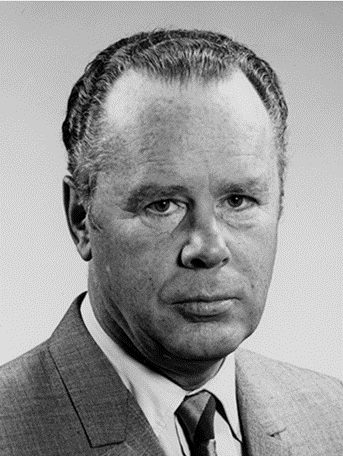
James Burnham, a strict logician, found the Sharon Statement “false and contradictory.” Bill Rusher privately admitted he had “never been entirely at ease with Meyer’s (and Evans’, and the Sharon Statement’s, and my own) rather too breezy assumption that a large amount of individual freedom somehow tends to maximize the opportunities to lead a virtuous life.” A good fusionist, though, he kept his reservations quiet.
Buckley didn’t publish Niemeyer’s letter, in part because YAF was already growing rapidly.
A final fusionist document also arrived in 1960. Barry Goldwater’s The Conscience of a Conservative, ghost-written by Buckley’s brother-in-law, Brent Bozell. As Goldwater, Bozell contended conservatism meant freedom and order, a balance captured in the Constitution. From man’s spiritual dignity, Bozell-Goldwater found the basis of economic individualism. Conscience sold into the hundreds of thousands and made Goldwater a political star.
Whatever theoretical disagreements remained conservatives had manifested fusionism. To make men virtuous and society flourish, conservatives were for free markets and political liberty, stridently anti-communist, against labor, and eager to dismantle the New Deal state.
By the end of 1960, with National Review publishing Meyer, with the Sharon Statement in print, with Goldwater as a political figurehead, fusionism was a fait accompli. There was, however, still time for one last theoretical joust. The two champions were Frank Meyer (for Freedom) and Goldwater’s erstwhile ghostwriter, Brent Bozell (for Virtue). This is the debate everyone points to when they discuss fusionism.
Early in 1962, Frank Meyer was working on a book laying out his position. Drawing on it in an essay for National Review, he sketched out the contours of the debate pretty well. There were two main sides:
The one, which, for want of a better word, one may call the "traditionalist," puts its primary emphasis upon the authority of transcendent truth and the necessity of a political and social order in accord with the constitution of being.
The other, which, again for want of a better word, one may call the "libertarian," takes as its first principle in political affairs the freedom of the individual person and emphasizes the restriction of the power of the state and the maintenance of the free-market economy as guarantee of that freedom.
In doing this, Meyer was partly doctrinal policing, attacking both pacifist libertarians and theocrats. In general, though, he made his familiar argument in his wooden prose: “That fused position recognizes at one and the same time the transcendent goal of human existence and the primacy of the freedom of the person in the political order.”
Meyer insisted on the primacy of freedom on the grounds that coerced virtue was not virtue at all. He wrapped up his essay swearing fealty to the importance of virtue and finding the salutary fusion embedded in the American political tradition.
It should have been fine, but something about the essay twigged a response in Brent Bozell. The two were friends, but like Meyer, Bozell had been on his own intellectual journey. He and his family had recently decamped to Spain and he had become enamored with the Catholic culture there. He’d returned briefly in March, 1962, to speechify to 18,000 conservative youth at Madison Square Garden about defending the West. Compared to El Escorial, fusionism seemed insufficient.
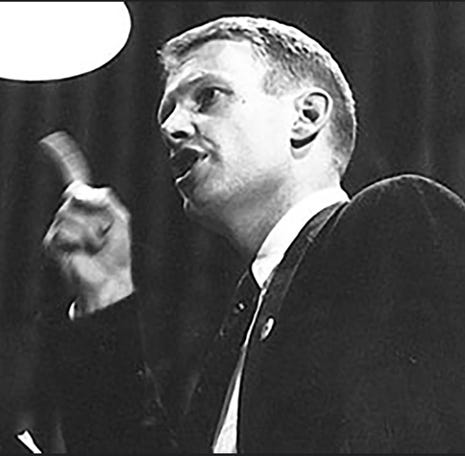
In a long and circuitous essay, Bozell assailed the foundations of fusionism. He questioned “whether the libertarian-traditionalist amalgam, as the fusionists define it, is worth bringing to power.” He doubted “whether a movement dominated by libertarianism can be responsive to the root causes of Western disintegration.” Bozell’s key point was, like other conservatives, rejecting the primacy of freedom. If “freedom is the ‘first principle’ in politics, virtue is, at best, the second one; and the programmatic aspects of the movement that affirms that hierarchy will be determined accordingly.” In other words: if the libertarians insist on a freedom first approach, this presumption will shape the entire movement in a libertarian direction.
Like Niemeyer, the anti-modernist Bozell criticized libertarianism and fusionist conservatism as hardly distinct from its “nineteenth-century precursor.” He criticized the Sharon Statement; he attacked Meyer’s argument that virtue must be freely chosen in order to be virtuous. If that was the case, he pointed out, we should remove all constraints on people sinning to ensure that every virtuous choice is as freely made as it can be. Bozell recognized this was an absurd suggestion, but submitted that “the inner logic of the dictum that virtue-not-freely-chosen is not virtue at all leads inescapably to the burlesque of reason we have suggested.” Bozell rejected other libertarian nostrums: particularly that economic and political liberty were necessarily entwined. Removing the primacy of freedom, Bozell argued, would open conservatism up to make prudential policy decisions. “We have, that is to say, liberated the discussion from the ideological strait jacket in which libertarian dogma confines it.”
Bozell forth the perennial traditionalist complaint: “The ‘compromise’ in question invariably consists in borrowing from the libertarians their principles and programs, and from the traditionalists the divine imprimatur.”
Niemeyer enjoyed how Bozell’s arguments mirrored his own from 1960. He told Buckley so in a letter, snarkily remarking that National Review seemed to have opened up its “margin of toleration” a little since then. Meyer swiftly responded. He protested that, despite his language of fusion, he wasn’t fusing anything. He was articulating “the instinctive consensus of the contemporary American conservative movement,” which, as Meyer had repeatedly argued, was not a construct, but inspired “by devotion to the fundamental understanding of the men who made Western civilization and the American republic.” He reiterated his basic position. There was an objective moral order, man’s end was the pursuit of virtue, and individual freedom was the “decisive necessity” for a good political order. Whatever Bozell thought, conservatives already had this “double allegiance.” You could see it in YAF, and, twisting the knife a bit, you could see it in Conscience of a Conservative.
Meyer also pointed out that he was policing the boundaries of conservatism, reading out totalitarian theocrats and anarchist libertarians. “It is only when virtue or freedom is wrenched out of the intrinsic interdependence in which they have existed in our tradition that ideological opposition arises.” Like Christian theology and the Trinity, any tilt of the delicate balance one way or another leads to heresy. And by the way, Meyer suggested, the inner logic of Bozell’s formulation of traditionalism led to theocracy.
Freedom was essential, Meyer argued, because of the state’s temptation to corruption, its temptation to impose eschatological visions by force, and its stifling effect on active, creative virtue.
Quite a few people wrote letters in encouraging one side or another. Later, Meyer referred to the “phenomenal” interest in the debate, although not everyone felt it worthwhile.
There were a couple other minor contributions – by Bill Rickenbacker and Richard Weaver – but the essential elements of the argument were in place. The traditionalist critique; the libertarian response; and the facts on the ground, where a fusionism of the trenches was already real.
Why Fusionism Failed
The 21st century is in some respects the product of fusionism, and the current New Right an unintended consequence. The dislocations of “liquid modernity” decried by present-day traditionalists are in part the result of the marketization sped up in the 1980s. The traditionalist critique of fusionism – that the primacy of individual and market economy – had a corrosive inner logic was essentially correct. There was very little room for conservatives to insist some greater good trumped individual rights. Traditionalists and social conservatives felt persistently betrayed by fusionism.
In his memoir, Richard Brookhiser writes, “The tersest definition of Reaganism that I ever heard” was ““Fight Communism; cut taxes; the pieties.” Reagan, Brookhiser argues, committed himself to the pieties, but in gestures only. He draped himself in the flag, he spoke to right-to-life groups and for pro-life journals, he endorsed evangelical ministers. But, Brookhiser wrote, “It is impressive to accomplish one thing in office, astonishing to accomplish two; three is in the never-never-land of many, and the pieties were Reagan’s third.”
True blue social conservatives like the (then) New Right felt let down by Reagan. They attacked his appointment of Sandra Day O’Connor to the Supreme Court, for instance. Or his possibly decisive 1978 opposition to California’s Prop 6. The despaired at his unwillingness to spend political capital on constitutional amendments for voluntary school prayer or curbing abortion. Some, like Phyllis Schlafly, took extreme umbrage at his Administration’s efforts to promote safe sex in response to the AIDS crisis. The decision drafted by Justice Anthony Kennedy, appointed by Reagan in 1987, in Obergefell v. Hodges was another blow to the social conservative position.
As Daniel Bell put it in 1985: “On the one hand, it espouses a populist individualism, anti-elite and anti-authority, emphasizing a ground of rights but justifying these largely in the economic sphere, but in the cultural realm defending a moral tutelage based on ‘traditional values’ and an unlovely notion of cold virtue. Reaganismus is a political hippogriff.”
The bitterness engendered by the long-term failure of fusionist conservatism – from Reagan to Bush and Bush and onward – to turn back, if not modernity, at least the sexual and rights revolution, hardened into paleoconservatism, the alt-right, and now the New Right. This is why social conservatives were so eager to bury fusionism.
But we sometimes fail to recognize how far out the fusionist position was, at least in Meyer’s formulation. A naturally extreme thinker, Meyer (and, frankly, the others in his circle) considered New Deal liberalism and the mid-century American state incorrigibly statist and collectivist. In Meyer’s telling, the traditionalist and libertarian strains of the Right had made common cause against the “the collectivism and statism that emanates from indigenous Liberalism and simultaneously to repel and overcome the Communist attack upon Western civilization.” We see then that at the basis of fusionism was a category error about the nature of modern liberalism and the state. Meyer equated the two, combining the Cold War liberalism of the ADA with the Soviet and Chinese communists as “modern collectivism.” It’s a breath-taking move. Although it stands to reason that a nocturnal former Stalinist ideologue would have a questionable ability to judge the merits of political regimes.
When pushed, Meyer explained that he saw no function for the state beyond national defense, maintenance of order, and the administration of justice, since each of these rely on the state’s legitimate monopoly of violence. Anything else “can be performed by individual persons and voluntary associations of persons.” Meyer’s retreat to a strikingly minimal state and his insistence on the indivisibility of economic from political freedom opens an extraordinary space for the market.
As Niemeyer, Bozell and others realized at the time, the fusionist placement of primacy on political (and therefore economic) liberty wended through politics, culture, and society. Conservatives shifted, maybe even at an unconscious level - a gauzy half thought, an assumption – from civic republicanism to individualism. The logic of politics became linked to choice and price and economics and rights. Culture was implicitly delegated to the amoral economic sphere, and the deregulated and increasingly financialized market sped up the disruptive impacts of capitalism. Some of this was probably inevitable to a greater or lesser extent, but fusionists accelerated it and exposed themselves by failing to recognize the probable impacts of the market and by denying themselves an effective tool for regulation.
The “primacy of the freedom of the person in the political order” is a softly phrased theoretical acid wash that would burn away any constraint on an individual. Deneen argues very much from within this tradition that after the erosion of culture that results from individualism, perversely all that is left is the state. To say nothing of the fusionists strengthen the state’s intelligence and warfighting powers against communism through a process that amounted to military Keynesianism.
It is incredible that Meyer was so worried about the risks of sinful man wielding state power, but blithely unconcerned about the aggregate effects of sinful man acting in an unconstrained market. Part of this imbalance was the result of the Cold War. The fusionists thought the state (because of the communist menace and because they were fundamentally Americans) was a unique menace.
In any case, it warped the fusionist analysis by foreclosing the possibility of a less existential, more prudential, more pluralistic form of liberalism.
Yet for his references to prudence, Bozell was also an extremist. Meyer identified a theocratic impulse in the “inner logic” of Bozell’s thought, and he wasn’t wrong. Bozell’s thought and intense religious commitments quickly led him into a fringe proto-Integralism. As early as 1962, when he entered the debate with Meyer, Bozell had already been workshopping a thesis about “God’s civilization” that made even his ideological allies nervous. In short order, Bozell left the realm of realistic politics for mystical obscurity.
To some extent the traditionalist failure was inevitable. It’s not clear to me what policies the traditionalist partisans could have proposed. The New Right’s social conservative efforts in the 1980s would, I think, strike most Americans as crude and retrograde. Sophisticated neoliberals already had an array of policies. It’s also not clear to me that the conservatives could have proposed a thicker commitment to a religious or metaphysical outlook without descending into theocracy or shattering their group unity. Despite their outlook, the metaphysical conservatives were Americans and could hardly shake their birthright pluralist, even – whisper it – liberal, assumptions.
The traditionalists wanted forestall modernity. But they also foreclosed use of the state to do so (in part because they were moderns too). So much of the Right’s present radicalism is recognizing this perceived failure or abdication: hence the dread fascination with Franco, Salazar and other Red Caesars. The present Right is much more radical, because they feel that they come from a place of loss – although this feeling in itself is mediated through nostalgia, memory, and pop cultural depictions.
There is value in a political outlook that prudentially balances virtue and liberty, that lives in this tension: it would be a moderate, conservative form of liberalism or republicanism, like that explored by the early neoconservatives and, to be honest, found in much of the American political tradition.
Fusionism failed because of the contradiction in its basic tenets, and the decision to prioritize liberty over virtue. But is also failed because its basic assumptions: about liberalism, about the state, about the relationship between political and economic freedom, and about modernity were extreme and, to some extent, or another faulty.
But, at long last, there is a way in which fusionism succeeded and continues to succeed. Shortly after Goldwater’s electoral defeat in 1964, Frank Meyer worried that conservatives had “constructed a demonology to contemplate rather than an avant garde to move forward, theorize, and explore.” The incomplete fusionist synthesis had bolted, become a dogma in the hands of YAF members who would become New Right activists and so on. It was held together precisely by that demonology: the hatred of liberalism and its equation with communism. Buckley, Meyer et al intended fusionism to unite the Right on the political stage. Shorn of most ideological or policy content, this aspect – the unity of fusionism against a demonized liberalism and Left – has proved startlingly durable.
These complaints almost identically mirror those made by social conservatives in the 1980s. In 1986, for example, Gregory Wolfe witnessed “increasingly rapid decay of the American social fabric over the last two decades, evident in the rise of pornography, abortion on demand, divorce, venereal disease, and teenage suicide.” Clyde Wilson lamented “the proliferation of divorce, pornography, rape, perversion, child abuse, abortion, and callousness.” And George Carey argued “The New Right is primarily interested in what we have come to term the social issues, such as prayer in the public schools, abortion, crime in the streets, busing, and pornography.”
You may recognize “inner logic” as a term used by Patrick Deneen in his Why Liberalism Failed. In fact, the idea of “inner logic” was used by key disputants in arguments over fusionism in the early 1960s. Deneen’s intellectual lineage places him within the tradition of the fusionist debates, and the arguments he levels against “liberalism” are actually applicable to the parts of the fusionist debate, which I think he was working within and very obviously on the traditionalist side.
Although the most prominent, Kirk was actually on the right-wing of this group, and facilitated its merger with the Republican Right.
They included Niemeyer and Parry, Brent Bozell, Richard Weaver, Revilo P. Oliver, and publisher Henry Regnery.
Very eloquently written and interesting! And I appreciate how you noted the whig angle, yeah thats at they were, in fact I think in some senses, our two parties were secretly taken over by two factions of the old whigs.
I wish people knew about just radical their (and their post war counterparts in the Dems) program truly was/is, and how effectively contrary and in some ways even anti the American tradition it was/is. Our system was radically transformed in the 1970s/1980s: the advent of the Neoliberal Era in the USA was far more radical than commonly understood, for example, its most profound structural transformations were in banking and finance, dismantling systems that, with few exceptions, were not New Deal era constructs as we are typically taught, but rather institutions that had existed in some cases since the nation's founding and others that had been established by the Jacksonians in the 1830s and 1840s. The USA was never a Keynesian state in the European sense; even at the height of the New Deal in the 1930s, it retained a politically semi-decentralized, economically semi-decentralized, and scientifically semi-decentralized structure with deliberate redundancy and policy variability, including in economic governance. Unlike Europe, where state-led economic planning was more centralized, the U.S. system maintained substantial regional and institutional diversity well into the postwar decades. The neoliberal turn of the 1970s and 1980s did not simply undo a mid-century Keynesian order but instead marked the dissolution of deeply ingrained mechanisms of economic diffusion, financial checks, and local policy autonomy. features that had long balanced national integration with fragmentation, generating competition, innovation, and resilience and were deep and fundamental elements of a long evolving socio-political project that note that descended from the European Enlightenment.
And the darkest comedy of all is that its effectively the diametrical opposite of what their program claimed/claims to be because it effectively instituted central planning, just via the private sector. In the latter 20th century, banking and finance were centralized through deregulation that removed barriers to interstate banking and the various capital flow inhibitors that had existed fully for ~140 years since the 1830s, allowing a small number of financial institutions to dominate investment and capital allocation. This concentrated control over credit, investment, and mergers, favored supers over smaller and medium firms. At the same time, interlocking directorates created a management superstructure that made coordination between large firms, limiting competitive pressures while coordinating decision making related to investment allocations and many other things. Big consultancies, which serve as gatekeepers to corporate strategy, further reinforced this by standardizing business practices and ensuring that only a handful of firms dictated industry wide decisions.
Business schools also played a role in socio-professionally homogenizing corporate leadership, producing executives trained in the same ideologies, reinforcing managerial consolidation, and ensuring that corporate decision-making adhered to a centralized logic rather than competitive market forces. Meanwhile, various other forms of cartelization, such as industry-wide lobbying for nationally harmonized regulatory (and remember, the word regulatory applies to several very different things), regulatory capture, or informal agreements enabled by all of the above, further insulated dominant firms from competition while coordinating activity, turning industries into private-sector equivalents of planned economies.
This is private sector central planning: a system where key economic decisions are made not through open market competition and politically and economically diffused decision making by large and diffused groupings of variegated actors but through a tightly controlled network of financial institutions, corporate boards, and consulting firms and other that coordinate strategies, allocate resources, and shape markets from the top down. The structure of economic power has shifted from a decentralized, competitive environment to one where market outcomes are largely dictated by a concentrated elite operating within a quasi-coordinated system that mirrors central planning, except it's done by private entities rather than the gov (although the gov plays a big role but 1) this concentration has made those actors drivers of state decision making and 2) the state itself has become very centralized by the removal of states and localities from real economy economic matters and 3) the govs themselves have seen similar homogenizing of decision makers along with stark declines in broader population and small/medium business representation)
Superb post. Given the centrifugal forces within conservatism, what is the glue that binds the libertarians to the Dominionists/Integralists? Once you start trying to balance virtue and liberty, the center-right of the Democratic Party starts exerting a gravitational pull. What counters this? A kind of political oppositional-defiant disorder?